Cats of Ephesus Map: A Cat-Spotting Walk from Gate to Gate
In brief
Is there a map of the cats of Ephesus?
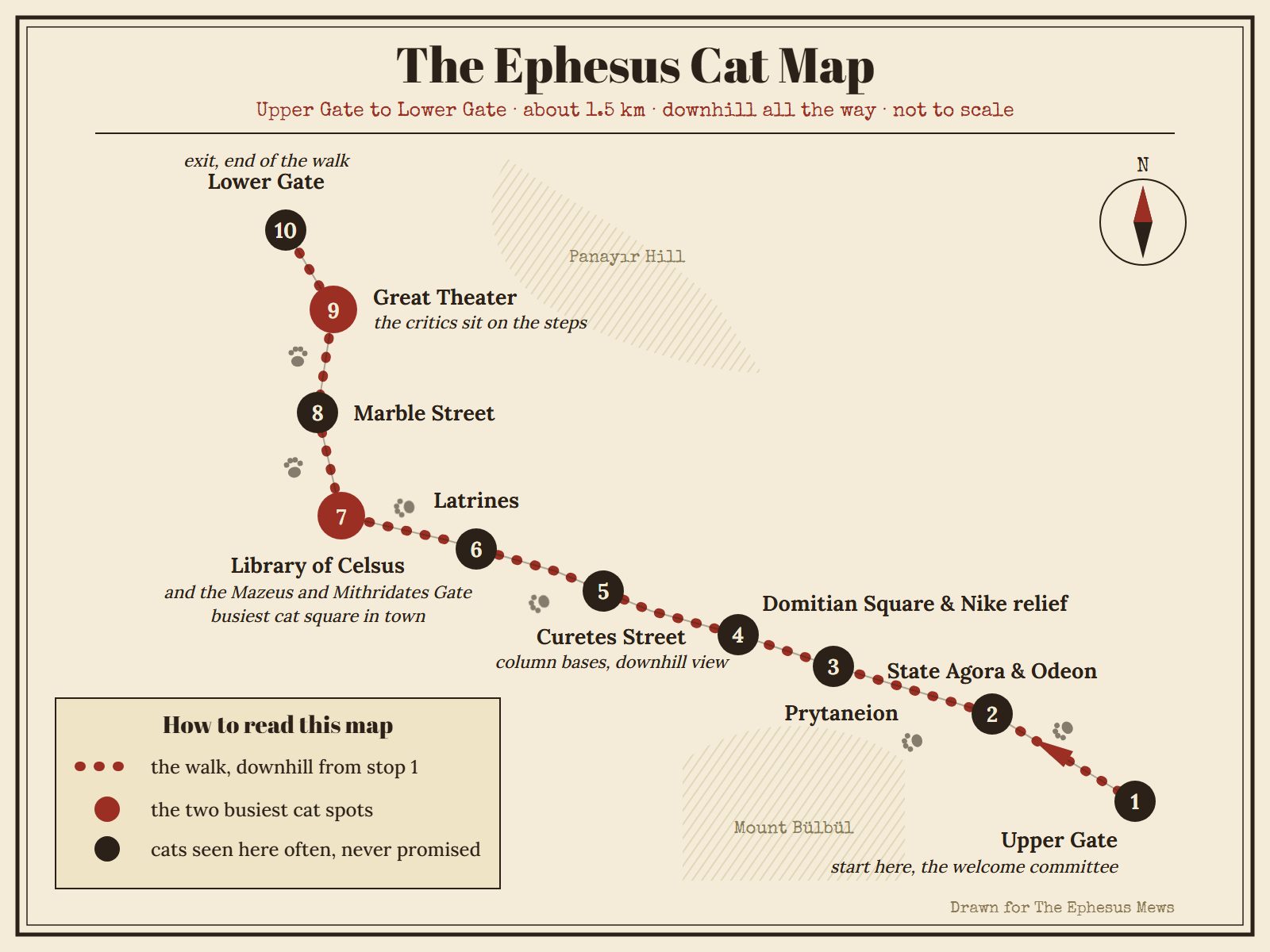
Yes, this one. The cats of Ephesus gather at a handful of reliable spots along the main street, so the easy way to meet them is to walk about 1.5 km downhill from the Upper Gate to the Lower Gate. The busiest stops are the Library of Celsus square and the Great Theater.
No app, no GPS, just ten stops and a lot of whiskers. Your editor draws the route he walks every week and tells you who usually sits where.
This cats of Ephesus map is the route I walk with my guests every week: in through the Upper Gate, about 1.5 km downhill along the marble streets, and out through the Lower Gate. Around 150 to 200 cats live inside the ancient city, and most of them keep to the same few spots along that line.
People ask me for a map of the cats all the time, usually right after the third cat has walked across their photo. So here it is, drawn by hand for the Mews. One honest warning before we start: cats are not statues. These are the places where I see them most often, not appointments. The residents keep their own diaries.
Where can you see the cats in Ephesus?
You can see the cats in Ephesus all along the main walking route, but they gather most at the Library of Celsus square, on Curetes Street and in the Great Theater. Smaller groups sit around the State Agora, the Prytaneion and the Latrines, mostly early and late in the day.
The ten stops below follow the map in order. I start at the Upper Gate because that is where most guided visits to Ephesus begin, mine included, and because the whole walk is then downhill. A few groups start at the Lower Gate when guests ask for it, have trouble walking or are short on time. The cats do not mind which way you come.
Which cats live near the Upper Gate and the State Agora?
Stop 1, the Upper Gate. The first cat of the day is often waiting near the entrance, which is why our classified pages list Bes the Greeter as the official welcome committee. Say hello, then keep walking. The best is downhill.
Stop 2, the State Agora and the Odeon. The big open square of the upper city is all grass, fallen columns and warm stone, which is cat furniture of the highest grade. Look along the column drums on the edge of the square and on the seats of the small Odeon, the roofed hall of about 1,500 seats where the city council met.
Stop 3, the Prytaneion. This was the town hall where the sacred flame of Hestia was kept burning. Today the flame is gone, but there is often a cat sitting by the standing columns, and our classifieds call her the Flame Keeper. You can read more about the building in this piece on the Prytaneion.
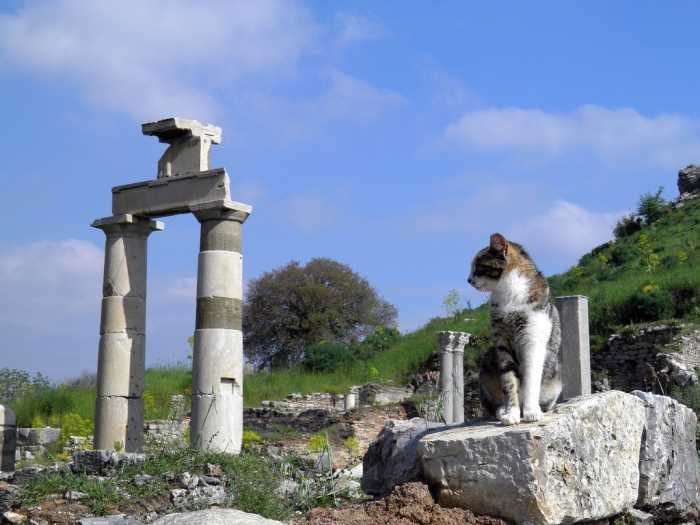
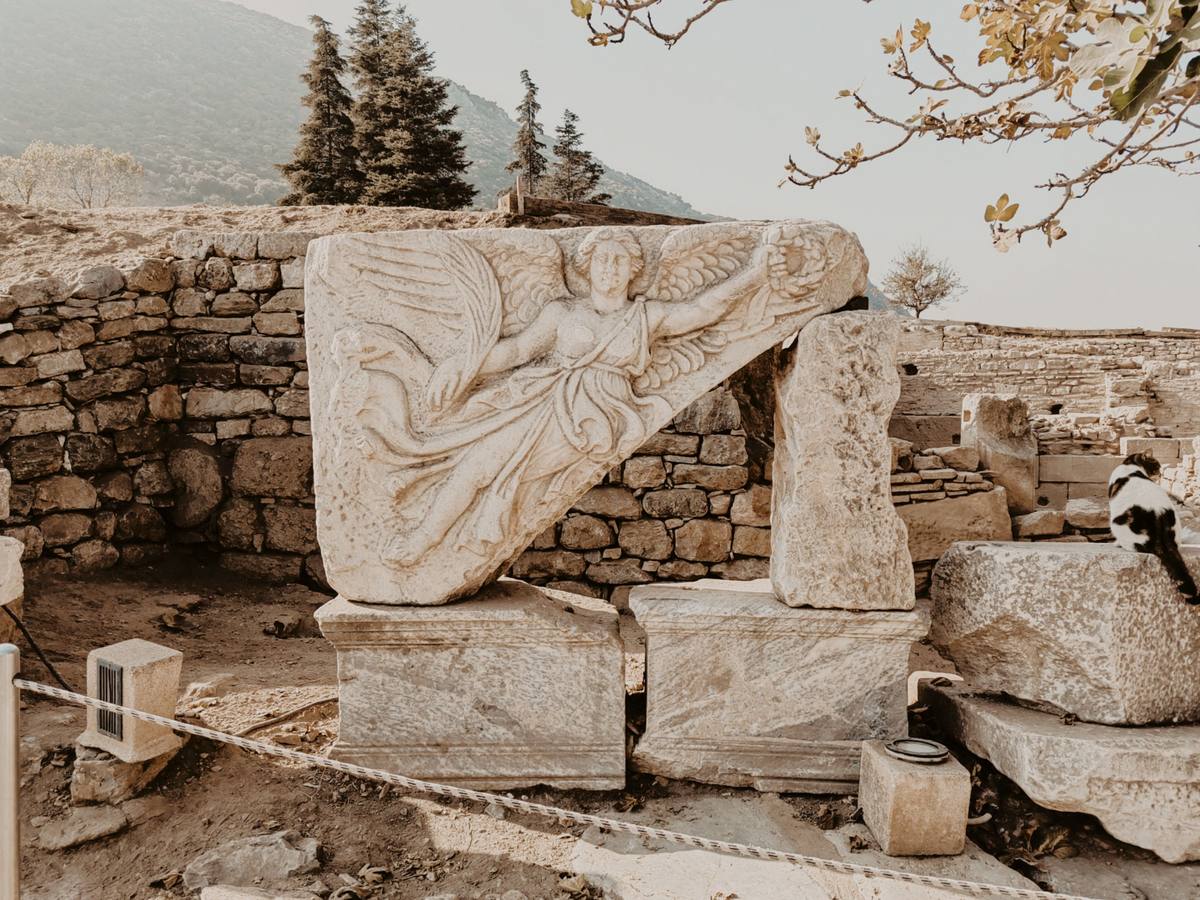
Stop 4, Domitian Square and the Nike relief. Just past the Prytaneion the street drops toward the winged goddess of victory carved in marble. Cats like the blocks around her, and I wrote about the goddess side of that story in our report on the Greek goddess of cats.
Where are the cats on Curetes Street?
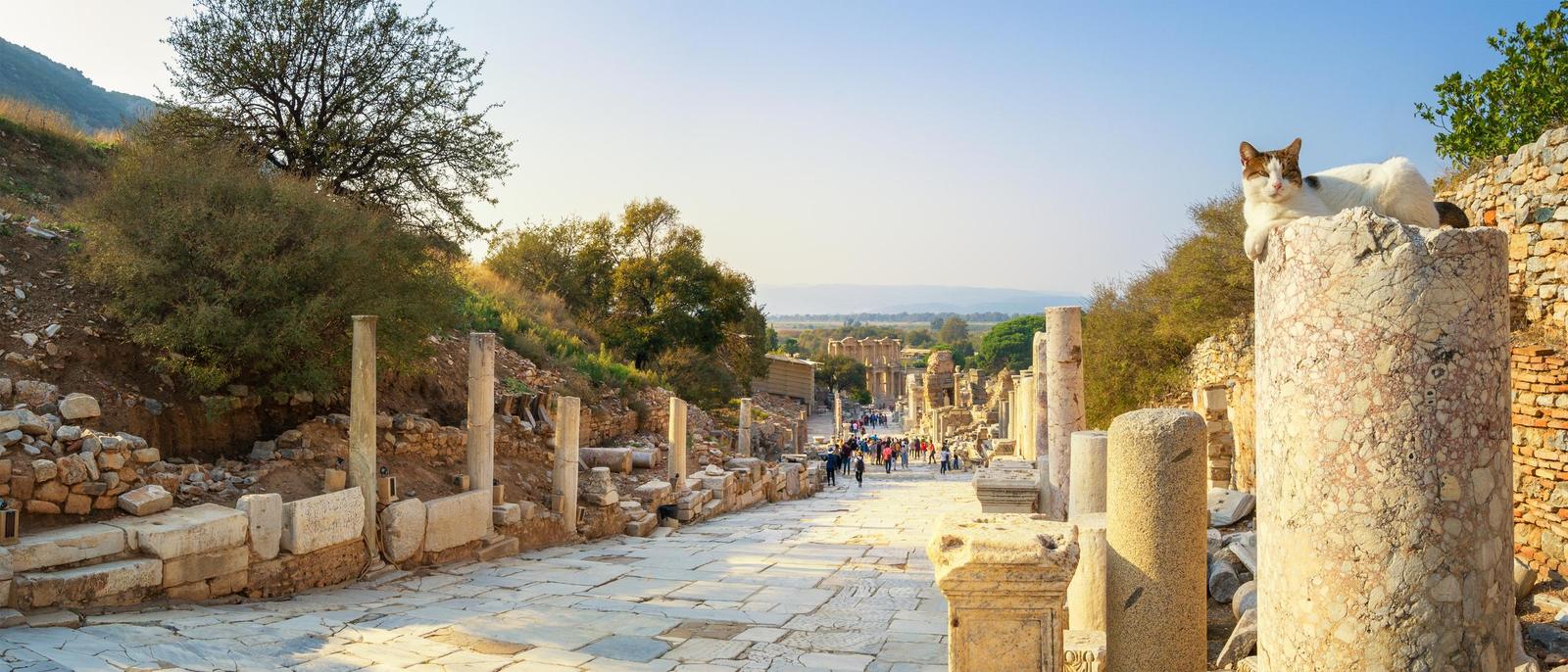
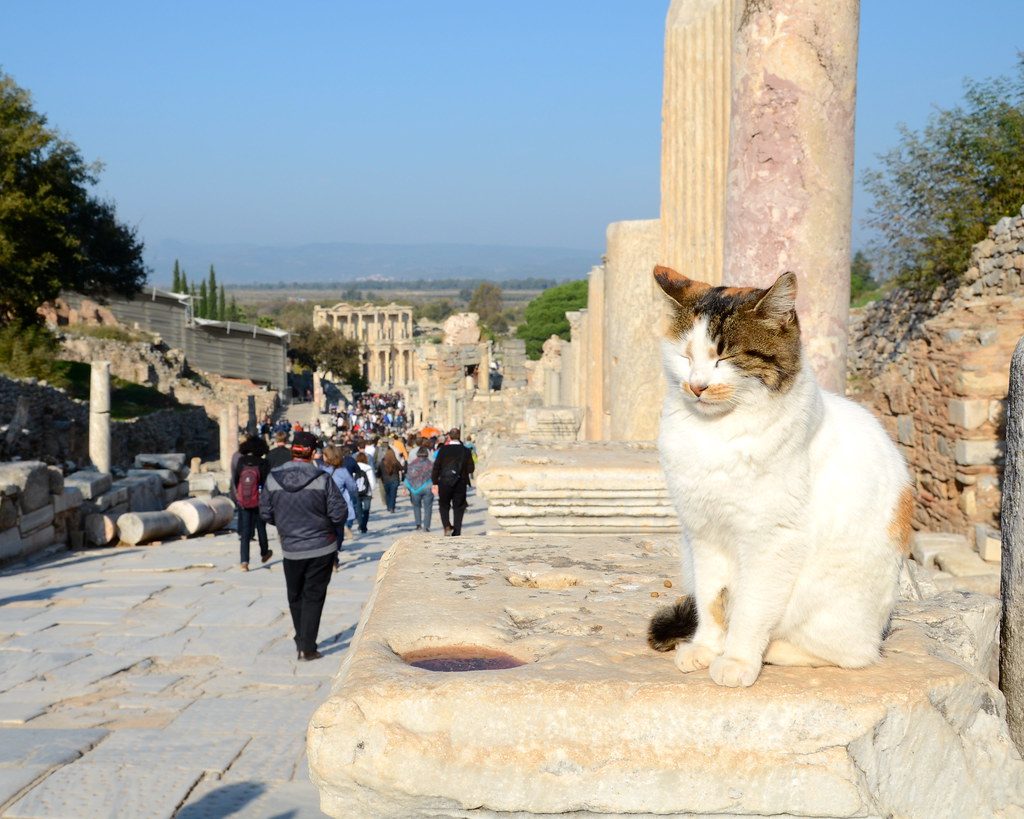
Stop 5, Curetes Street. This is the most photographed street in Ephesus and the cats know it. They sit on the column bases and the inscribed blocks along both sides, usually facing downhill toward the library, which gives you the classic picture: one cat in front, the Library of Celsus far below. Walk slowly here. Half the cats on this street are asleep in plain sight.
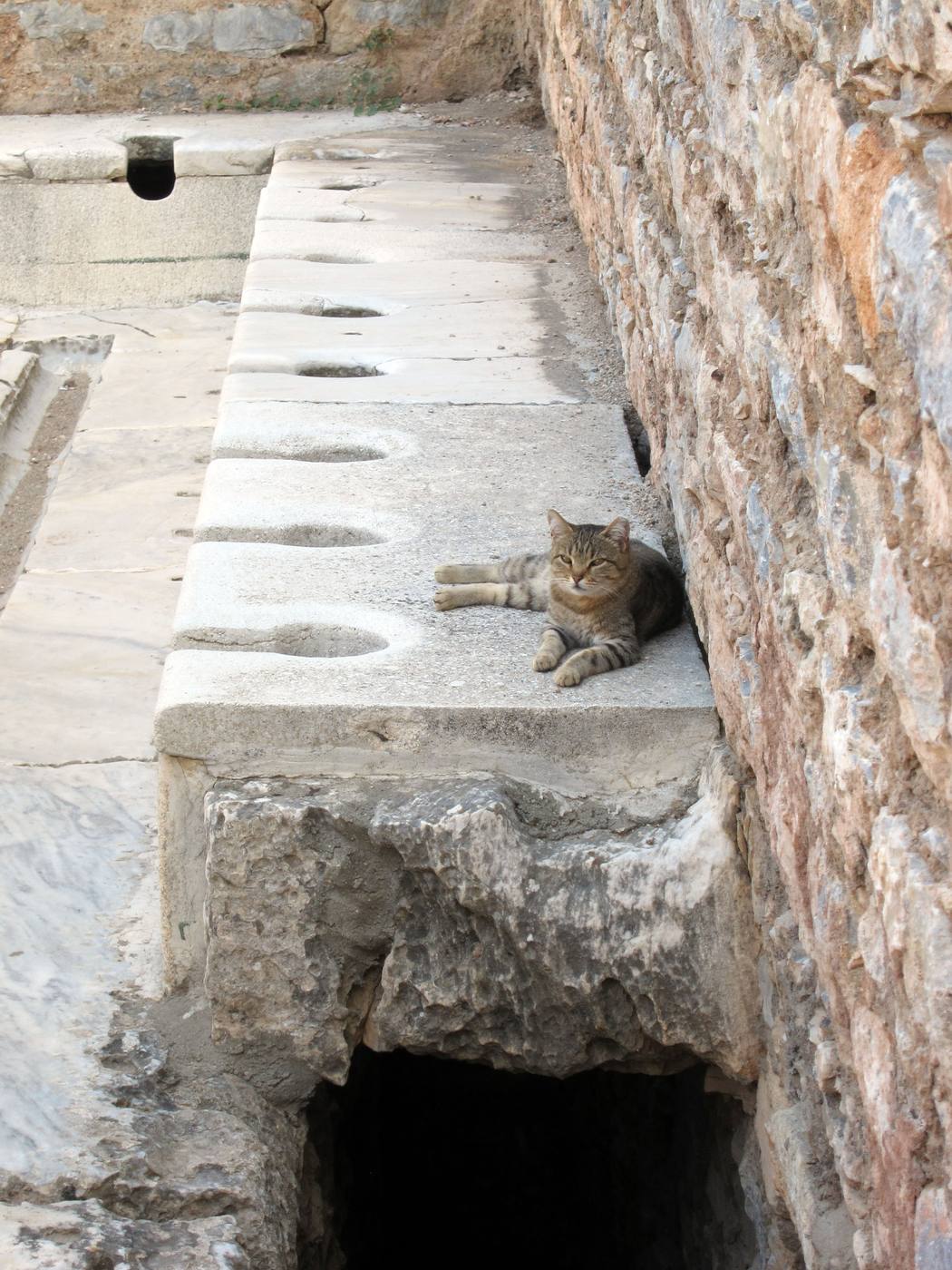
Stop 6, the Latrines. The public toilets of the Roman city sit just off Curetes Street, a long marble bench with a row of keyhole seats and no walls between them. The Romans came here to chat. The cats come here because the bench is smooth, shaded and very quiet.
Is there a cat at the Library of Celsus?
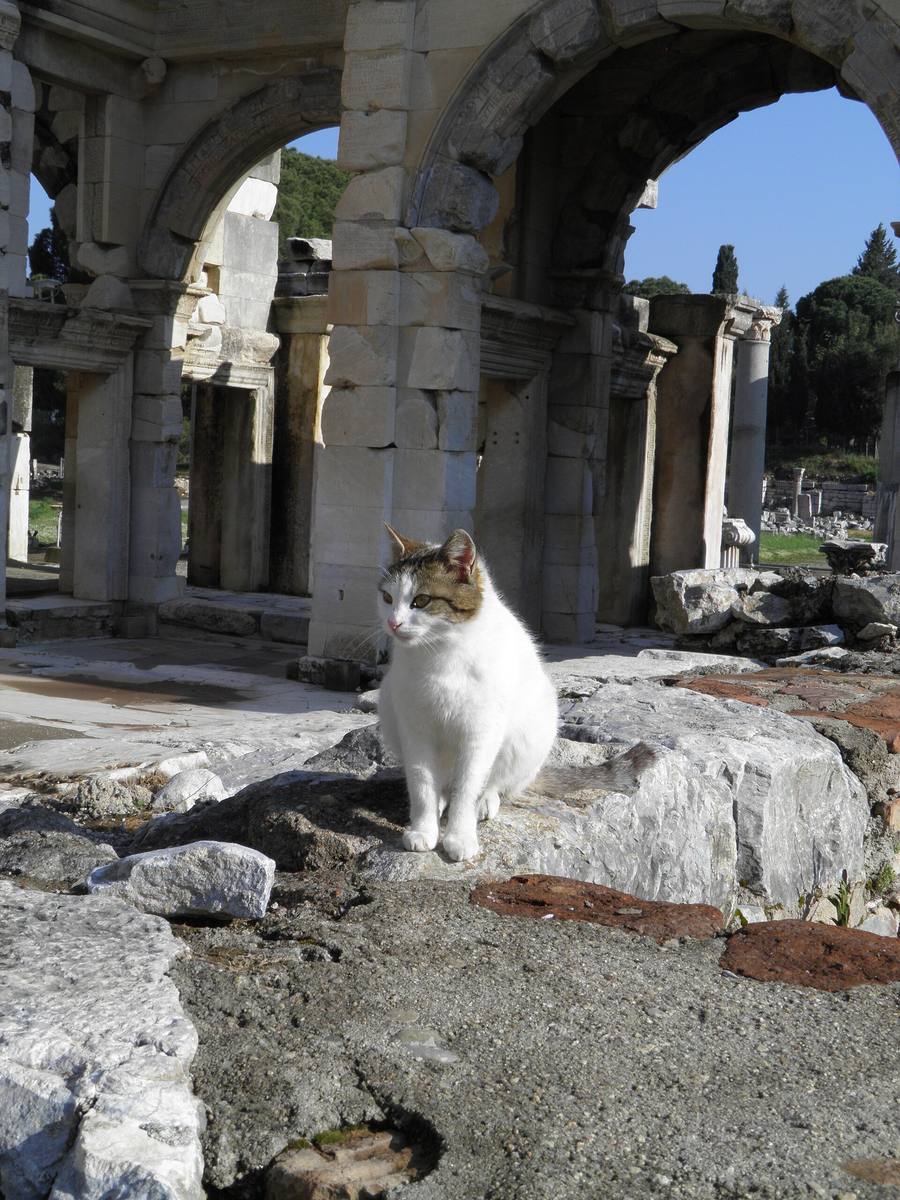
Stop 7, the Library of Celsus square. Yes, almost always more than one. The square in front of the library is the busiest cat spot on the whole map, and it is where Kleopatra, the Queen of the Library in our classifieds, holds court. The library was built in the second century AD as a tomb and memorial for the governor Celsus, and its facade was rebuilt by archaeologists in the 1970s. More on that in this guide to the Library of Celsus.
Right beside the library stands the triple arch of the Mazeus and Mithridates Gate, built by two freed slaves of the family of Emperor Augustus. Cats like the rubble walls on either side of the arches, so look left of the library as well as straight at it.
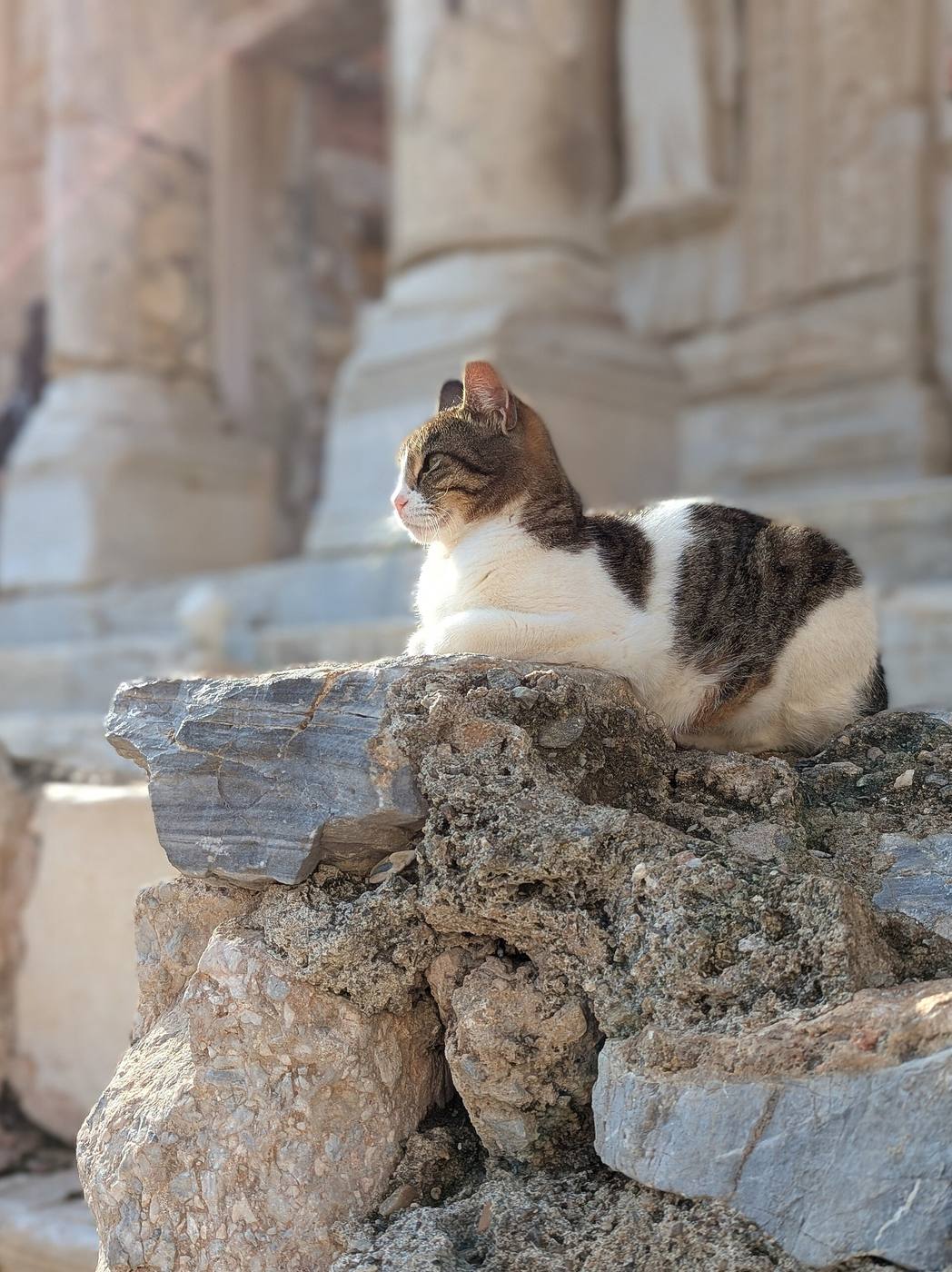
Where do the cats sit on Marble Street and in the Great Theater?
Stop 8, Marble Street. From the library square the route turns north up the paved road to the theater. Cats use the long marble curbs here as a corridor, and you will often meet one walking the same way as you, slightly ahead and refusing to explain.
Stop 9, the Great Theater. The second busiest cat spot in town. The theater held around 24,000 people in Roman times, and today a few of its seats are taken by our theater critics, who move up and down the rows in the sun. If you climb a little way up the steps you will see them better, and you get the best view back down the harbor road too. Read more in this piece on the Great Theater.
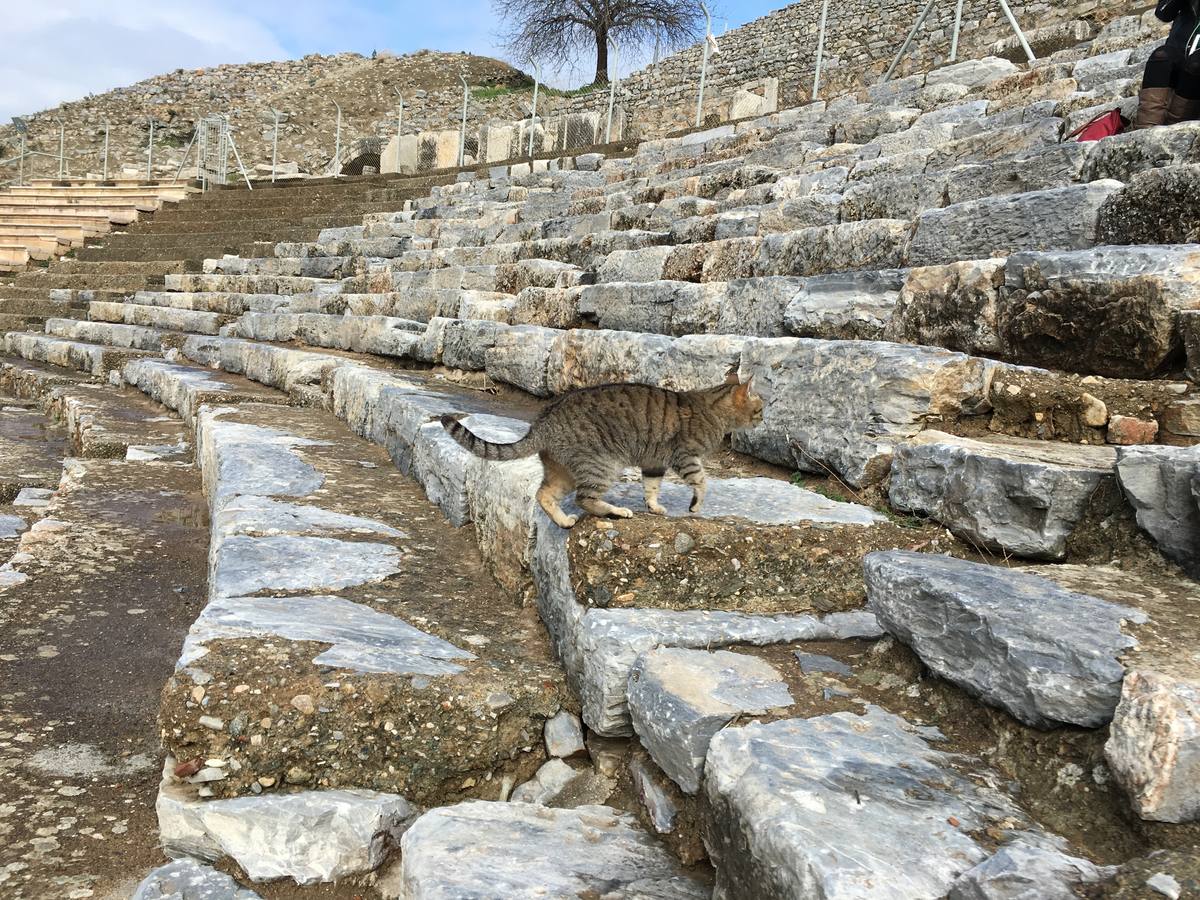
Stop 10, the Lower Gate. The walk ends here, and so does the cat map. There are cats near the exit too, but by now you have met the important ones.
How do you meet the cats politely?
- Let the cat come to you. Most of them are friendly, but they choose.
- If you want to feed them, bring proper cat food, not chips or sandwiches, and a little water helps on hot days.
- Do not lift them onto the ruins for a photo. They are already on the ruins.
- Keep to the paths. The cats can climb the marble, visitors should not.
The full rules are in the public notices on the front page, and the best of the portraits are in our photo desk. If you wonder why there are so many cats here at all, I answered that in our very first edition.
These are the places where I see them most often, not appointments. The residents keep their own diaries.
Can a guide show you the cats of Ephesus?
Yes, and it is one of my favorite parts of the job. I walk Ephesus every week, I know where the regulars like to sit, and I can tell you the history of every stop on this map while we look for them. If you would like every stop with a story, hire me as your guide for Ephesus and we will walk it together, cats included, at their pace and yours.
Letters to the Editor
Are there cats in Ephesus, Turkey?
Yes. Around 150 to 200 cats live inside the ancient city of Ephesus. Site staff, guards, local vets and guides look after them. — The Editor 🐾
Where are the most cats in Ephesus?
In front of the Library of Celsus. The library square and the Great Theater are the two busiest spots, followed by Curetes Street, the State Agora, the Prytaneion and the Latrines. — The Editor 🐾
Is there a cat at the Library of Celsus?
Usually, yes. Most days at least one cat is sitting in the square or on the rubble beside the Mazeus and Mithridates Gate, though no single cat keeps a timetable. — The Editor 🐾
When is the best time to see the cats in Ephesus?
Early morning and late afternoon. In the middle of a hot day most cats are asleep in the shade, so look under the column blocks rather than on top of them. — The Editor 🐾
Will I have to walk back uphill after the cat walk?
Usually not. Most guided visits start at the Upper Gate and finish at the Lower Gate, so the walk is downhill and your driver meets you at the bottom. — The Editor 🐾